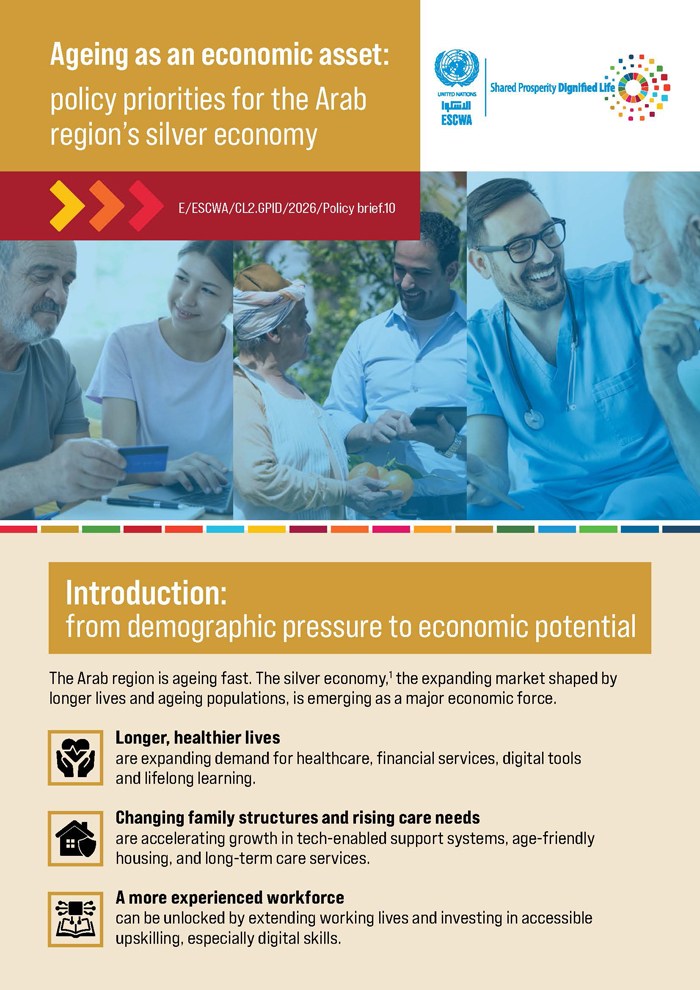

ESCWA Publication: E/ESCWA/CL2.GPID/2026/Policy brief.10
Country: Arab region, Kingdom of Bahrain, Arab Republic of Egypt, Hashemite Kingdom of Jordan, Lebanese Republic, Kingdom of Morocco, Sultanate of Oman, Kingdom of Saudi Arabia
Publication Type: Policy briefs
Cluster: Gender Justice, Population and Inclusive Development
Focus Area: Inclusive development
Initiatives: Reducing inequalities
SDGs: Goal 3: Good Health and Well-Being, Goal 10: Reduced Inequalities
Keywords: Ageing, Arab countries, Bahrain, Digital literacy, Economic conditions, Egypt, Financial inclusion, Healthcare delivery, Lebanon, Morocco, Oman, Policy making, Productive ageing, Recommendations, Saudi arabia, Workforce, Jordan
Ageing as an economic asset: policy priorities for the Arab region’s silver economy
October 2026
The Arab region is ageing fast. The number of people aged 60+ has jumped from 11.5 million in 1990 to 36 million today, and will soar to nearly 94 million by 2050, totalling 13% of the population. This shift is already changing how people spend, work and live. Longer lives and rising care needs are fuelling demand for better healthcare, smarter financial services, digital tools, age friendly housing, and opportunities to keep learning. Moreover, older adults bring decades of experience that can strengthen the workforce.
Despite this potential, many older people, especially those in informal jobs, still face barriers that limit their ability to participate fully in the economy. Markets remain fragmented, services are uneven, and innovation is slower than the pace of demographic change. Fixing these barriers opens the door to new industries, new jobs, and new ways of supporting ageing with dignity. If countries and companies act now, the silver economy could make up around 20% of all economic activity in the Arab region by mid century. With the right policies and partnerships, ageing can become a source of economic strength, creating a more resilient, inclusive and prosperous future for the region.
Related content
Inclusive development
The Arab region is ageing fast. The number of people aged 60+ has jumped from 11.5 million in 1990 to 36 million today, and will soar to nearly 94 million by 2050, totalling 13% of the population. This shift is already changing how people spend, work and live. Longer lives and rising care needs are fuelling demand for better healthcare, smarter financial services, digital tools, age friendly housing, and opportunities to keep learning. Moreover, older adults bring decades of experience that can strengthen the workforce.
Despite this potential, many older people, especially those in informal jobs, still face barriers that limit their ability to participate fully in the economy. Markets remain fragmented, services are uneven, and innovation is slower than the pace of demographic change. Fixing these barriers opens the door to new industries, new jobs, and new ways of supporting ageing with dignity. If countries and companies act now, the silver economy could make up around 20% of all economic activity in the Arab region by mid century. With the right policies and partnerships, ageing can become a source of economic strength, creating a more resilient, inclusive and prosperous future for the region.