

ESCWA Publication: E/ESCWA/CL5.SDGS/2026/RFSD/Background paper.1
Country: Arab region, Republic of Djibouti, Arab Republic of Egypt, Republic of Iraq, Hashemite Kingdom of Jordan, Lebanese Republic, Kingdom of Morocco, Republic of Sudan, Syrian Arab Republic
Publication Type: Information material
Cluster: 2030 Agenda and SDG Coordination
Focus Area: 2030 Agenda
Initiatives: Monitoring Sustainable Development Goal Data, Arab Forum for Sustainable Development
SDGs: Agenda 2030, Goal 7: Affordable and Clean Energy
Keywords: Arab countries, Djibouti, Egypt, Energy consumption, Energy services, Energy transfer, Gulf states, Iraq, Jordan, Lebanon, Morocco, Renewable energy sources, Sudan, Syrian arab republic, Trade routes, War
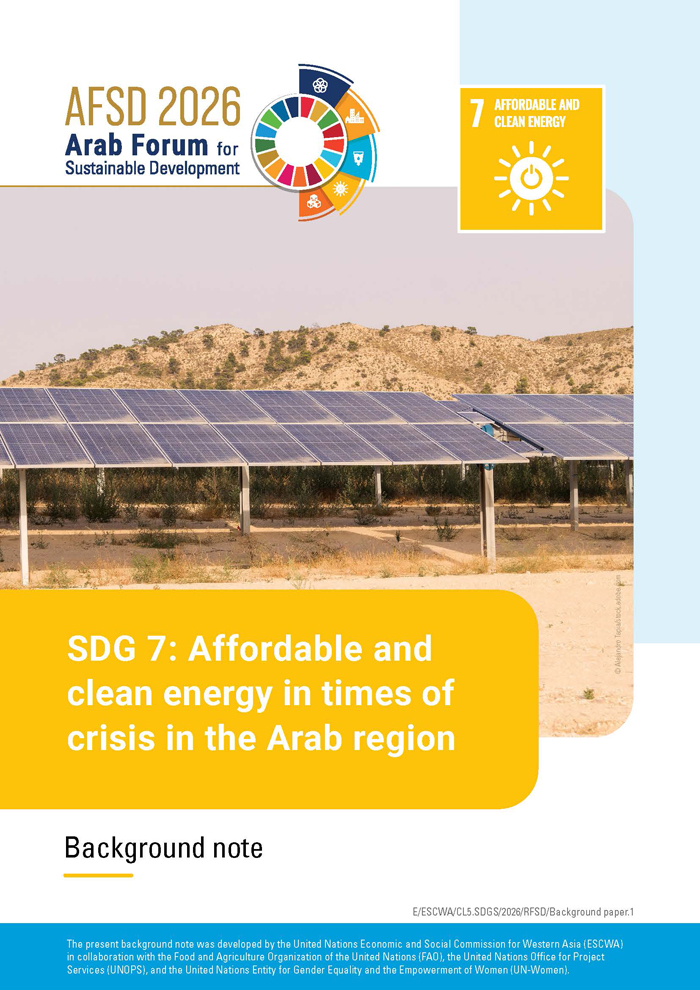
SDG 7: Affordable and clean energy in times of crisis in the Arab region
May 2026
The present background note highlights progress and persistent gaps in achieving Sustainable Development Goal 7 amid systemic risks in the Arab region. While electricity access has surpassed 92 per cent, around 38.5 million people still lack access, and gaps in access to clean cooking remain significant, particularly in rural areas and fragile settings. Progress on renewable energy and energy efficiency also remains limited, with renewable energy accounting for less than 5 per cent of total energy consumption.
The note underscores how recent conflicts and geopolitical disruptions have exposed the region’s vulnerability to shocks in energy systems, increasing costs, constraining supply chains and delaying investments in clean energy. These challenges disproportionately affect low-income and conflict-affected countries, exacerbating inequalities and undermining energy security.
To close the gap by 2030, the background note calls for a shift from access-focused indicators towards measuring reliable, affordable and sustainable energy services. It emphasizes the need to accelerate energy transitions, strengthen regional cooperation and interconnection, diversify energy systems, and adopt inclusive policies that address rural, gender and vulnerability dimensions. Building resilient energy systems will be critical to ensuring long-term sustainability and stability across the Arab region.
- Accelerating inclusive implementation of SDG 6 for improved resilient water security in the Arab region
- SDG 7: Affordable and clean energy in times of crisis in the Arab region
- Advancing SDG 9 in times of crisis: a focus on infrastructure in the Arab region
- Arab cities on the frontline: advancing SDG 11 amid escalating crises
Related content
2030 Agenda
The present background note highlights progress and persistent gaps in achieving Sustainable Development Goal 7 amid systemic risks in the Arab region. While electricity access has surpassed 92 per cent, around 38.5 million people still lack access, and gaps in access to clean cooking remain significant, particularly in rural areas and fragile settings. Progress on renewable energy and energy efficiency also remains limited, with renewable energy accounting for less than 5 per cent of total energy consumption.
The note underscores how recent conflicts and geopolitical disruptions have exposed the region’s vulnerability to shocks in energy systems, increasing costs, constraining supply chains and delaying investments in clean energy. These challenges disproportionately affect low-income and conflict-affected countries, exacerbating inequalities and undermining energy security.
To close the gap by 2030, the background note calls for a shift from access-focused indicators towards measuring reliable, affordable and sustainable energy services. It emphasizes the need to accelerate energy transitions, strengthen regional cooperation and interconnection, diversify energy systems, and adopt inclusive policies that address rural, gender and vulnerability dimensions. Building resilient energy systems will be critical to ensuring long-term sustainability and stability across the Arab region.
- Accelerating inclusive implementation of SDG 6 for improved resilient water security in the Arab region
- SDG 7: Affordable and clean energy in times of crisis in the Arab region
- Advancing SDG 9 in times of crisis: a focus on infrastructure in the Arab region
- Arab cities on the frontline: advancing SDG 11 amid escalating crises