
Country: Hashemite Kingdom of Jordan
Publication Type: Information material
Cluster: Gender Justice, Population and Inclusive Development
Focus Area: Governance & enabling environment, Future of employment, Natural resource sustainability
Initiatives: Job creation, Development challenges
SDGs: Goal 6: Clean Water and Sanitation, Goal 8: Decent Work and Economic Growth, Goal 13: Climate Action
Keywords: Accessibility, Capacity building, Climate change, Communication technology, Cultural heritage, Decent work, Development finance, Drinking water, Economic growth, Employment, Financial services, Governance, Housing, Industry, Information technology, Jordan, Market access, Parks, Partnership, Physical infrastructure, Resilience, Sanitation, Scientific research, Stakeholder engagement, Sustainable development, Sustainable transport, Urban planning, Urbanization, Water resources, Technical cooperation, Technological innovations
Irbid's pathway to a sustainable and resilient future: first voluntary local review
February 2026
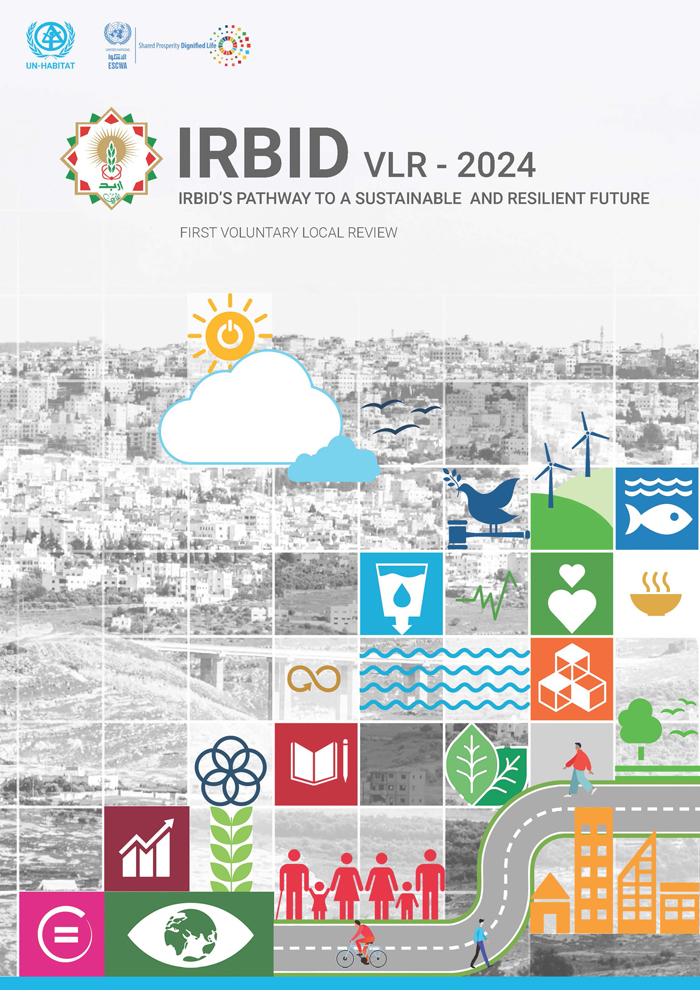
The 2024 Irbid Voluntary Local Review (VLR) presents the city’s first comprehensive assessment of progress in localizing the sustainable development goals (SDGs), aligned with Jordan’s national development frameworks, including the Economic Modernization Vision (EMV) and the Jordan National Urban Policy (JNUP). Led by the Greater Irbid Municipality (GIM), in partnership with United Nations Human Settlements Programme (UN-Habitat) and the United Nations Economic and Social Commission for Western Asia (UNESCWA), the VLR adopts an evidence-based and participatory approach grounded in multi-stakeholder engagement, data analysis and action-oriented recommendations.
The review focuses on six priority goals, namely SDGs 6, 8, 9, 11, 13, and 17, while integrating cross-cutting themes related to refugees, young people, gender equality and persons with disabilities. It highlights progress in urban planning, wastewater management and climate governance, while identifying persistent challenges related to water scarcity, unemployment, infrastructure financing and data availability. By positioning Irbid as a regional reference for SDG localization, the VLR serves as a living framework to support continuous monitoring, accountability and coordinated action toward a more inclusive, green and resilient city.
Related content
Governance & enabling environment, Future of employment, Natural resource sustainability
The 2024 Irbid Voluntary Local Review (VLR) presents the city’s first comprehensive assessment of progress in localizing the sustainable development goals (SDGs), aligned with Jordan’s national development frameworks, including the Economic Modernization Vision (EMV) and the Jordan National Urban Policy (JNUP). Led by the Greater Irbid Municipality (GIM), in partnership with United Nations Human Settlements Programme (UN-Habitat) and the United Nations Economic and Social Commission for Western Asia (UNESCWA), the VLR adopts an evidence-based and participatory approach grounded in multi-stakeholder engagement, data analysis and action-oriented recommendations.
The review focuses on six priority goals, namely SDGs 6, 8, 9, 11, 13, and 17, while integrating cross-cutting themes related to refugees, young people, gender equality and persons with disabilities. It highlights progress in urban planning, wastewater management and climate governance, while identifying persistent challenges related to water scarcity, unemployment, infrastructure financing and data availability. By positioning Irbid as a regional reference for SDG localization, the VLR serves as a living framework to support continuous monitoring, accountability and coordinated action toward a more inclusive, green and resilient city.