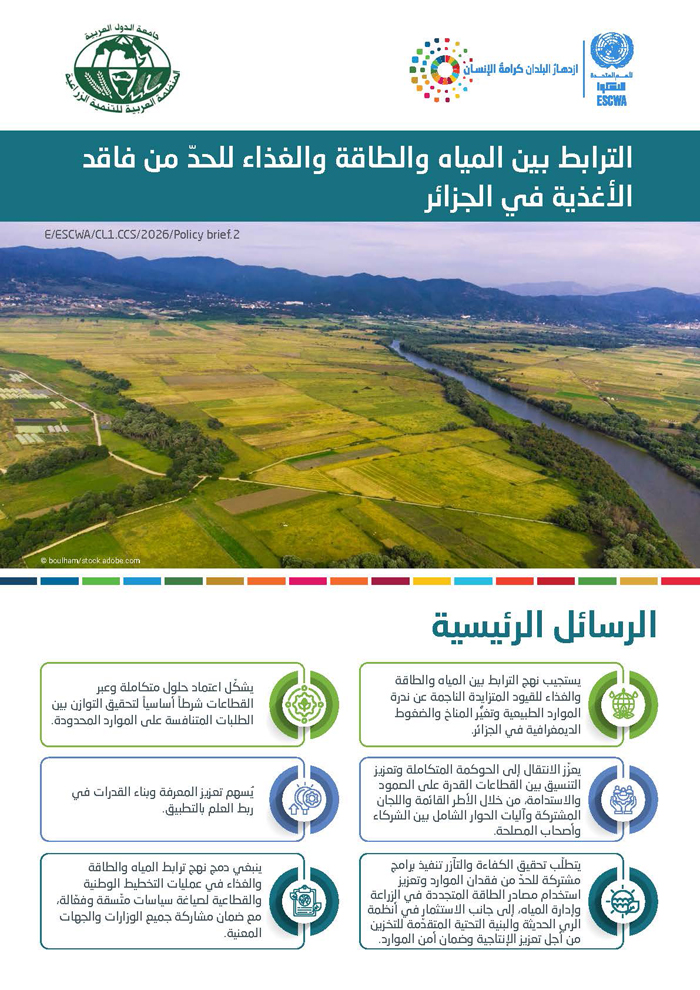
ESCWA Publication: E/ESCWA/CL1.CCS/2026/Policy brief.2
Country: People’s Democratic Republic of Algeria
Publication Type: Policy briefs
Cluster: Climate Change and Natural Resource Sustainability
Focus Area: Climate change, Natural resource sustainability
Initiatives: Water-Energy-Food nexus support to post-COVID-19 recovery
SDGs: Goal 2: Zero Hunger, Goal 11: Sustainable Cities and Communities, Goal 13: Climate Action
Keywords: Agricultural development, Agricultural productivity, Algeria, Capacity building, Climate change, Energy efficiency, Energy security, Food loss, Food security, Information exchange, Intersectoral cooperation, Natural resources development, Policy making, Recommendations, Resilience, Stakeholder engagement, Sustainable development, Water resources development, Technical cooperation
Water–energy–food nexus for reducing food loss in Algeria
March 2026
Algeria is facing increasing challenges in managing its natural resources amid climate change, population growth and rising demand for water, energy and food. These challenges are exacerbating food loss, affecting food security, and threatening environmental and economic sustainability. Such challenges are no longer separate or confined to individual sectors; rather, they are closely interlinked, underscoring the need for integrated approaches that go beyond traditional sector-based management. In this context, the water–energy–food nexus emerges as a strategic framework for addressing structural gaps, improving resource efficiency, reducing waste, and strengthening the resilience of national systems to climate and economic pressures, in line with national development priorities and the Sustainable Development Goals.
The present policy brief explores the potential for applying the nexus approach in Algeria, with a focus on its role in reducing food loss along supply chains. It reviews the main challenges hindering implementation, including weak cross-sectoral governance, limited cross-cutting capacities and skills, inadequate integrated data, investment complexity and the absence of harmonized indicators to measure progress. The brief highlights a set of intervention areas to strengthen integrated governance, expand stakeholder engagement, build institutional and technical capacities, and improve policy coordination and data exchange. It aims to support decision makers through practical measures for applying the nexus approach, thereby improving resource efficiency, reducing food loss, and advancing the transition towards more sustainable and resilient water, energy and food systems in Algeria.
Related content
Climate change, Natural resource sustainability
Algeria is facing increasing challenges in managing its natural resources amid climate change, population growth and rising demand for water, energy and food. These challenges are exacerbating food loss, affecting food security, and threatening environmental and economic sustainability. Such challenges are no longer separate or confined to individual sectors; rather, they are closely interlinked, underscoring the need for integrated approaches that go beyond traditional sector-based management. In this context, the water–energy–food nexus emerges as a strategic framework for addressing structural gaps, improving resource efficiency, reducing waste, and strengthening the resilience of national systems to climate and economic pressures, in line with national development priorities and the Sustainable Development Goals.
The present policy brief explores the potential for applying the nexus approach in Algeria, with a focus on its role in reducing food loss along supply chains. It reviews the main challenges hindering implementation, including weak cross-sectoral governance, limited cross-cutting capacities and skills, inadequate integrated data, investment complexity and the absence of harmonized indicators to measure progress. The brief highlights a set of intervention areas to strengthen integrated governance, expand stakeholder engagement, build institutional and technical capacities, and improve policy coordination and data exchange. It aims to support decision makers through practical measures for applying the nexus approach, thereby improving resource efficiency, reducing food loss, and advancing the transition towards more sustainable and resilient water, energy and food systems in Algeria.