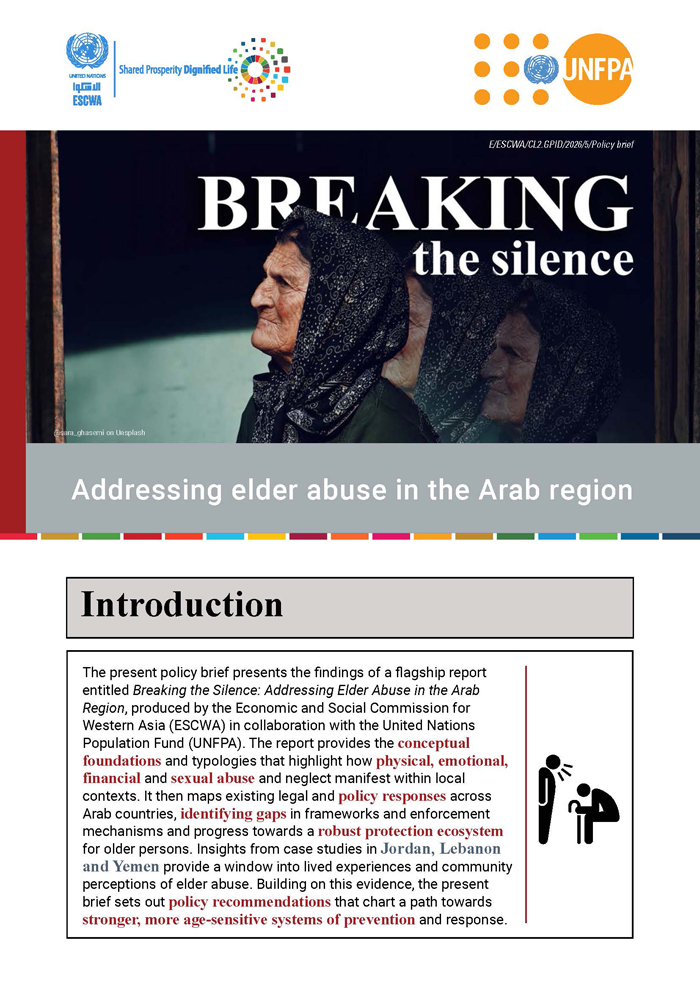

ESCWA Publication: E/ESCWA/CL2.GPID/2026/5/Policy brief
Country: Arab region, People’s Democratic Republic of Algeria, Kingdom of Bahrain, Arab Republic of Egypt, Republic of Iraq, Hashemite Kingdom of Jordan, State of Kuwait, Lebanese Republic, Sultanate of Oman, State of Palestine, Kingdom of Saudi Arabia, Federal Republic of Somalia, Republic of Tunisia, United Arab Emirates, Republic of Yemen
Publication Type: Policy briefs
Cluster: Gender Justice, Population and Inclusive Development
Focus Area: Inclusive development, Population dynamics & migration
Initiatives: Older persons, Reducing inequalities
SDGs: Goal 3: Good Health and Well-Being, Goal 10: Reduced Inequalities
Keywords: Algeria, Arab countries, Bahrain, Care of ageing persons, Domestic violence, Economic aspects, Egypt, Elder abuse, Financial aspects, Government policy, Institutionalized persons, Iraq, Jordan, Kuwait, Lebanon, Legal aspects, Negligence, Oman, Psychological aspects, Recommendations, Saudi arabia, Sexual offences, Somalia, State of palestine, Tunisia, United arab emirates, Yemen
Breaking the silence: addressing elder abuse in the Arab region - policy brief
June 2026
Population ageing is emerging as a defining demographic trend in the Arab region, reshaping family structures, social relations and policy priorities. Longer life expectancy reflects important advances in health and development, yet it also draws greater attention to longstanding social challenges. Among these is elder abuse, whether physical, psychological, financial or through neglect. It has always existed but is now gaining prominence as the number of older persons grows. Such abuse undermines dignity and well-being, as well as social cohesion.
The present study, prepared jointly by the Economic and Social Commission for Western Asia (ESCWA) and the United Nations Population Fund (UNFPA), examines elder abuse in the Arab region across family, institutional and community settings. It identifies the manifestations, causes and impacts of abuse, while drawing attention to institutional, policy and social gaps that perpetuate the problem. Insights from case studies in Jordan, Lebanon and Yemen provide a window into lived experiences and community perceptions of elder abuse. Building on this evidence, the study concludes with a policy road map anchored in six overarching objectives, offering policy recommendations that chart a path towards stronger, more age-sensitive systems of prevention and response.
Related content
Inclusive development, Population dynamics & migration
Population ageing is emerging as a defining demographic trend in the Arab region, reshaping family structures, social relations and policy priorities. Longer life expectancy reflects important advances in health and development, yet it also draws greater attention to longstanding social challenges. Among these is elder abuse, whether physical, psychological, financial or through neglect. It has always existed but is now gaining prominence as the number of older persons grows. Such abuse undermines dignity and well-being, as well as social cohesion.
The present study, prepared jointly by the Economic and Social Commission for Western Asia (ESCWA) and the United Nations Population Fund (UNFPA), examines elder abuse in the Arab region across family, institutional and community settings. It identifies the manifestations, causes and impacts of abuse, while drawing attention to institutional, policy and social gaps that perpetuate the problem. Insights from case studies in Jordan, Lebanon and Yemen provide a window into lived experiences and community perceptions of elder abuse. Building on this evidence, the study concludes with a policy road map anchored in six overarching objectives, offering policy recommendations that chart a path towards stronger, more age-sensitive systems of prevention and response.