
ESCWA Publication: E/ESCWA/CL5.SDGS/2026/Policy brief.1
Country: Arab region, Global, Kingdom of Bahrain, Republic of Djibouti, Arab Republic of Egypt, Republic of Iraq, Hashemite Kingdom of Jordan, State of Kuwait, Lebanese Republic, State of Libya, Islamic Republic of Mauritania, Kingdom of Morocco, Sultanate of Oman, State of Palestine, State of Qatar, Kingdom of Saudi Arabia, Republic of Tunisia, United Arab Emirates
Publication Type: Policy briefs
Cluster: 2030 Agenda and SDG Coordination
Focus Area: 2030 Agenda
Initiatives: Monitoring Sustainable Development Goal Data, Arab Forum for Sustainable Development
SDGs: Agenda 2030
Keywords: Accessibility, Arab countries, Bahrain, Behavioural sciences, Djibouti, Economic growth, Egypt, Financial inclusion, Financial regulations, Financial services, Iraq, Jordan, Kuwait, Lebanon, Libya, Mauritania, Mexico, Morocco, Oman, Qatar, Saudi arabia, Social development, Socially disadvantaged persons, Stakeholder engagement, State of palestine, Sustainable development, Tunisia, United arab emirates, Electronic funds transfer
Enhancing the financial inclusion of underserved groups in the Arab region
February 2026
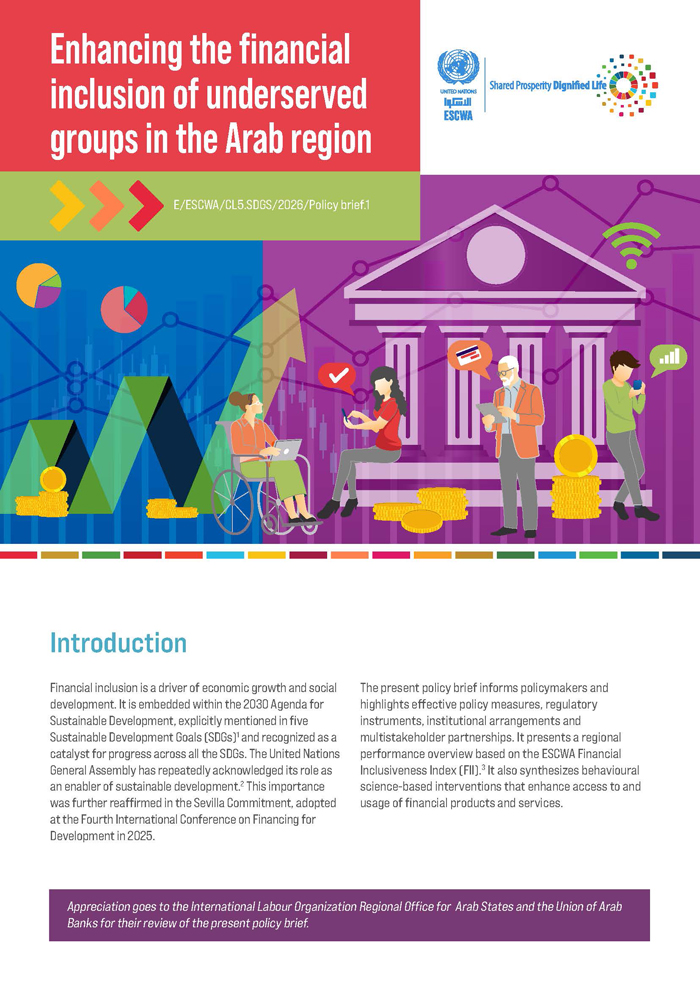
The present policy brief aims to inform policymakers on accelerating financial inclusion for underserved groups in the Arab region. It presents a regional performance overview using the ESCWA Financial Inclusiveness Index. Based on structural and regulatory barriers that limit access to financial products and services, the policy brief highlights effective policy measures, regulatory instruments, and institutional frameworks. Emphasis is placed on the role of different stakeholders and partnerships in building inclusive financial ecosystems.
The policy brief includes examples impacting different underserved groups including women, young people, persons with disabilities and micro, small and medium enterprises. It also synthesizes behavioural science-based interventions that enhance access to and usage of financial products and services.
Related content
2030 Agenda
The present policy brief aims to inform policymakers on accelerating financial inclusion for underserved groups in the Arab region. It presents a regional performance overview using the ESCWA Financial Inclusiveness Index. Based on structural and regulatory barriers that limit access to financial products and services, the policy brief highlights effective policy measures, regulatory instruments, and institutional frameworks. Emphasis is placed on the role of different stakeholders and partnerships in building inclusive financial ecosystems.
The policy brief includes examples impacting different underserved groups including women, young people, persons with disabilities and micro, small and medium enterprises. It also synthesizes behavioural science-based interventions that enhance access to and usage of financial products and services.