
ESCWA Publication: E/ESCWA/CL6.GCP/2026/Policy brief.1
Country: Global, Hashemite Kingdom of Jordan, Lebanese Republic, Kingdom of Morocco, Republic of Tunisia, Türkiye
Publication Type: Policy briefs
Cluster: Governance and Conflict Prevention
Focus Area: Trade & regional connectivity
Initiatives: Enhancing competition and consumer protection laws and policies
SDGs: Goal 9: Industry, Innovation and Infrastructure, Goal 12: Responsible Production and Consumption
Keywords: Competitiveness, Europe, Exports, Foreign trade, Imports, Incentives, Industrial policy, Jordan, Lebanon, Mexico, Morocco, Non-tariff barriers, Prices, Product quality, Productivity, Recommendations, Transport costs, Tunisia, Turkey, Value chains
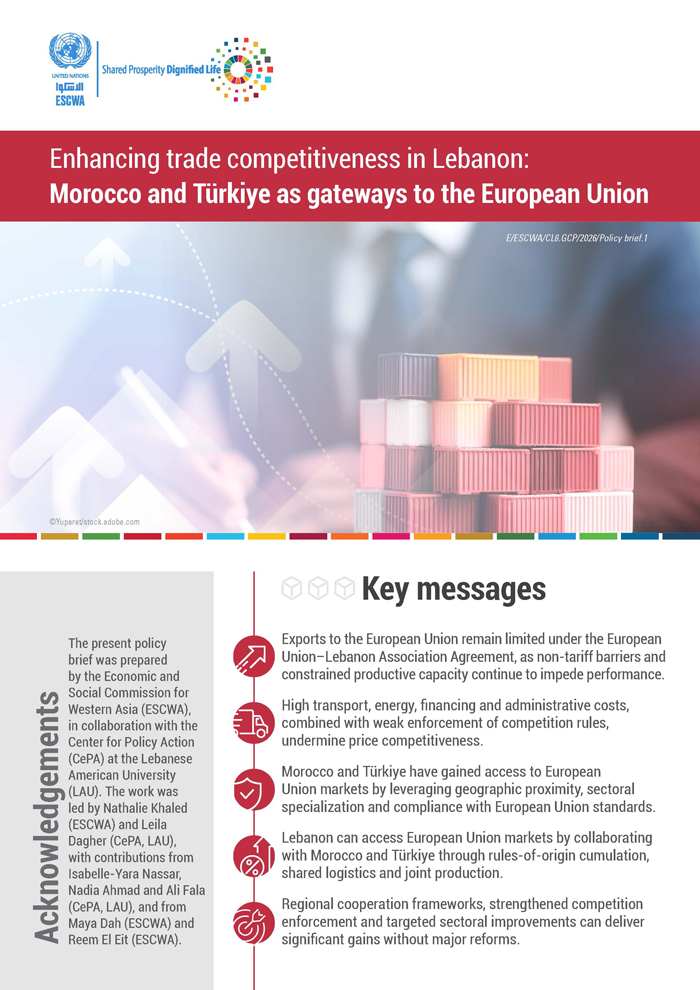
Enhancing trade competitiveness in Lebanon: Morocco and Türkiye as gateways to the European Union
June 2026
The trade deficit and weak exports performance in Lebanon persist despite preferential access to European Union markets, as non-tariff barriers and structural constraints limit firm competitiveness. These constraints include high logistics and input costs, limited productive capacity, weak competition enforcement and gaps in standards and conformity assessment systems, which undermine the ability of firms to meet European Union requirements.
This policy brief proposes integration into regional value chains through partnerships with Morocco and Türkiye as a practical pathway to indirect access to European Union markets. By leveraging rules-of-origin cumulation, shared logistics and specialization in intermediate inputs, Lebanon can strengthen competitiveness while building domestic productive capacity. Stronger competition enforcement, improved quality infrastructure and targeted sectoral support are essential to boost export performance and reduce structural trade imbalances.
Related content
Trade & regional connectivity
The trade deficit and weak exports performance in Lebanon persist despite preferential access to European Union markets, as non-tariff barriers and structural constraints limit firm competitiveness. These constraints include high logistics and input costs, limited productive capacity, weak competition enforcement and gaps in standards and conformity assessment systems, which undermine the ability of firms to meet European Union requirements.
This policy brief proposes integration into regional value chains through partnerships with Morocco and Türkiye as a practical pathway to indirect access to European Union markets. By leveraging rules-of-origin cumulation, shared logistics and specialization in intermediate inputs, Lebanon can strengthen competitiveness while building domestic productive capacity. Stronger competition enforcement, improved quality infrastructure and targeted sectoral support are essential to boost export performance and reduce structural trade imbalances.