
ESCWA Publication: E/ESCWA/CL2.GPID/2026/Policy brief.1
Country: Arab region, Arab Republic of Egypt
Publication Type: Policy briefs
Cluster: Gender Justice, Population and Inclusive Development
Focus Area: Inclusive development
Initiatives: Reducing inequalities
SDGs: Goal 10: Reduced Inequalities
Keywords: Arab countries, Egypt, Health insurance, Informal sector, Information systems, Social security, Social security legislation
Expanding social insurance for informal workers in the Arab region
January 2026
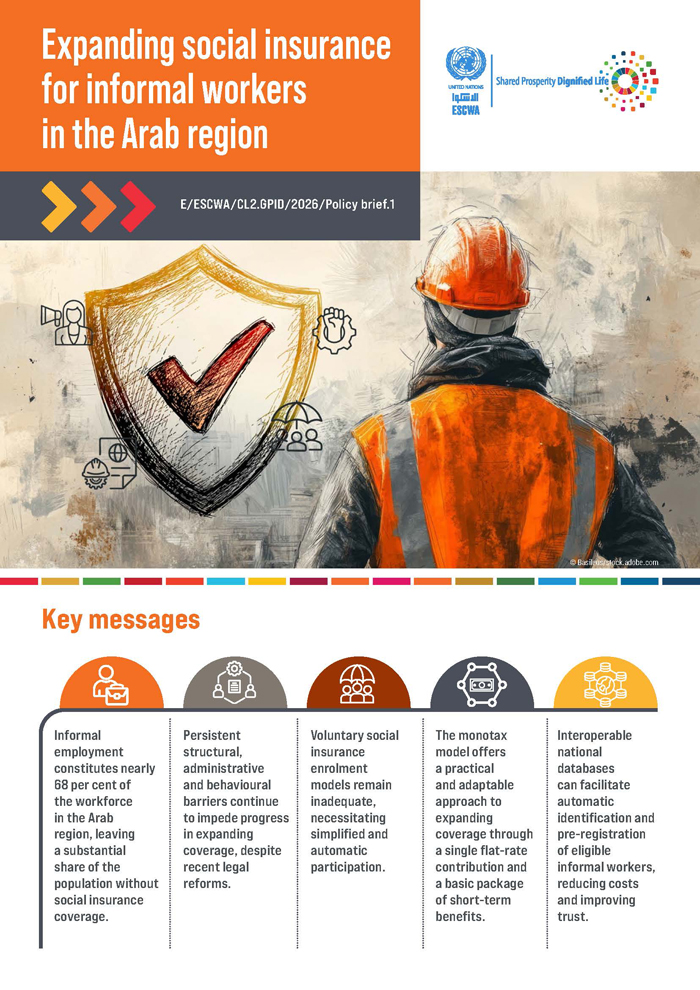
Informal employment constitutes nearly 70 per cent of the workforce in the Arab region, leaving millions of workers without access to essential social insurance benefits. Despite recent legal reforms in several countries, progress in expanding coverage has stagnated due to structural, administrative and behavioural barriers. Voluntary enrolment models have proven insufficient, particularly for workers with irregular incomes, limited trust in institutions and low awareness of their entitlements.
This policy brief analyses the key determinants of the region’s persistent coverage gaps and presents two practical pathways for achieving sustainable and scalable inclusion of informal workers: simplified monotax contribution schemes and automatic identification and pre-registration supported by interoperable databases. Together, these approaches can shift social insurance systems from voluntary “opt-in” enrolment to a model where coverage is the default, thereby reducing administrative burdens, improving equity, and strengthening financial sustainability.
Related content
Inclusive development
Informal employment constitutes nearly 70 per cent of the workforce in the Arab region, leaving millions of workers without access to essential social insurance benefits. Despite recent legal reforms in several countries, progress in expanding coverage has stagnated due to structural, administrative and behavioural barriers. Voluntary enrolment models have proven insufficient, particularly for workers with irregular incomes, limited trust in institutions and low awareness of their entitlements.
This policy brief analyses the key determinants of the region’s persistent coverage gaps and presents two practical pathways for achieving sustainable and scalable inclusion of informal workers: simplified monotax contribution schemes and automatic identification and pre-registration supported by interoperable databases. Together, these approaches can shift social insurance systems from voluntary “opt-in” enrolment to a model where coverage is the default, thereby reducing administrative burdens, improving equity, and strengthening financial sustainability.