ESCWA Publication: E/ESCWA/CL2.GPID/2026/TC.3/Guide
Country: Lebanese Republic
Publication Type: Information material
Cluster: Gender Justice, Population and Inclusive Development
Focus Area: Inclusive development
Initiatives: Reducing inequalities, Arab-European Research Network on Disability , Arab Digital Inclusion Platform, Realizing the rights of persons with disabilities
SDGs: Goal 10: Reduced Inequalities
Keywords: Children with disabilities, Deaf persons, Persons with mental disabilities, Blind persons, Autism, Family, Disability evaluation, Manuals, Capacity building, Lebanon, Rehabilitation
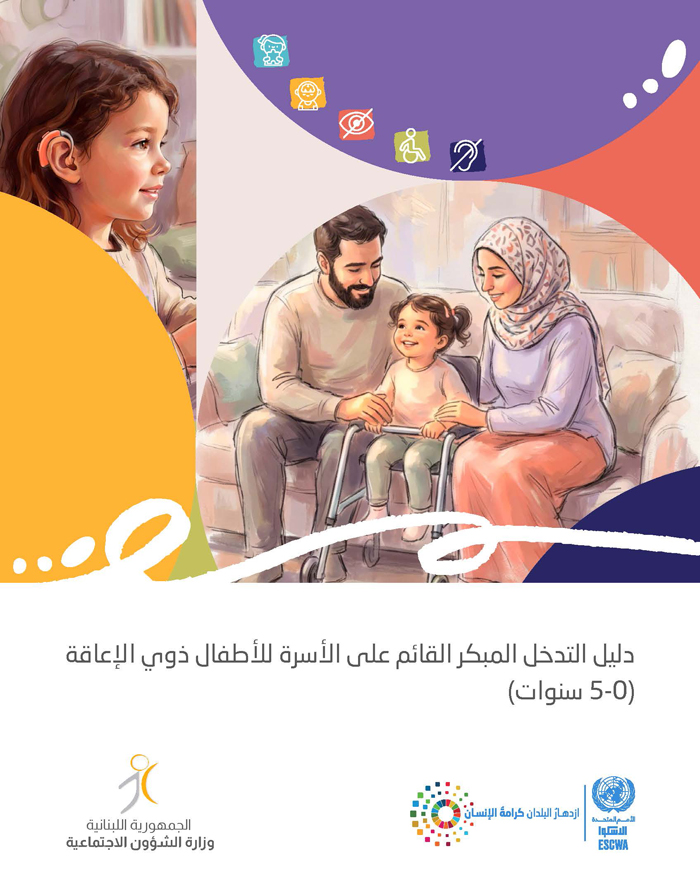
Family-based early intervention guide for children with disabilities aged 0–5 years
June 2026
The absence of early intervention programmes for children from birth to age 5 poses a significant threat to the development and social integration of children with disabilities, exacerbating the effects of disability and increasing its economic and social costs to the State. In Lebanon, early intervention services are limited to a small number of expensive specialized centres concentrated in cities, preventing most children and their families from accessing these essential services in a timely manner. While social development centres are widespread throughout the country and offer free services, they lack specialized programmes and services for disability and early childhood. There is therefore a clear need to bridge this gap in comprehensive community-based care.
In response to this reality, the present guide sets out a practical methodology for establishing early intervention programmes in community centres, focused on supporting families as the cornerstone of child development and empowerment. The guide is distinguished by its innovative approach, which focuses on training and guiding parents through specialized civil society organizations and organizations of persons with disabilities, thereby enabling them to develop their children’s abilities within their natural environment. The guide also focuses on empowering community centre staff members and building their organizational and professional capacities, so that they can gradually assume direct work with children and their families within a supportive and accessible environment, particularly in cases of mild or moderate disabilities. This is done within a framework of on-the-ground support and accompaniment provided by organizations of persons with disabilities and specialized associations, ensuring the quality, integration and sustainability of interventions. Strengthening the capacity of community centres to provide primary early intervention services supported by a network of specialists is a cost-effective and impactful option, as it contributes to reducing the effects of disability in the early stages, spares the State and families high costs in later stages, and paves the way for broader and more equitable inclusion of children with disabilities in society.
Related content
Inclusive development
The absence of early intervention programmes for children from birth to age 5 poses a significant threat to the development and social integration of children with disabilities, exacerbating the effects of disability and increasing its economic and social costs to the State. In Lebanon, early intervention services are limited to a small number of expensive specialized centres concentrated in cities, preventing most children and their families from accessing these essential services in a timely manner. While social development centres are widespread throughout the country and offer free services, they lack specialized programmes and services for disability and early childhood. There is therefore a clear need to bridge this gap in comprehensive community-based care.
In response to this reality, the present guide sets out a practical methodology for establishing early intervention programmes in community centres, focused on supporting families as the cornerstone of child development and empowerment. The guide is distinguished by its innovative approach, which focuses on training and guiding parents through specialized civil society organizations and organizations of persons with disabilities, thereby enabling them to develop their children’s abilities within their natural environment. The guide also focuses on empowering community centre staff members and building their organizational and professional capacities, so that they can gradually assume direct work with children and their families within a supportive and accessible environment, particularly in cases of mild or moderate disabilities. This is done within a framework of on-the-ground support and accompaniment provided by organizations of persons with disabilities and specialized associations, ensuring the quality, integration and sustainability of interventions. Strengthening the capacity of community centres to provide primary early intervention services supported by a network of specialists is a cost-effective and impactful option, as it contributes to reducing the effects of disability in the early stages, spares the State and families high costs in later stages, and paves the way for broader and more equitable inclusion of children with disabilities in society.