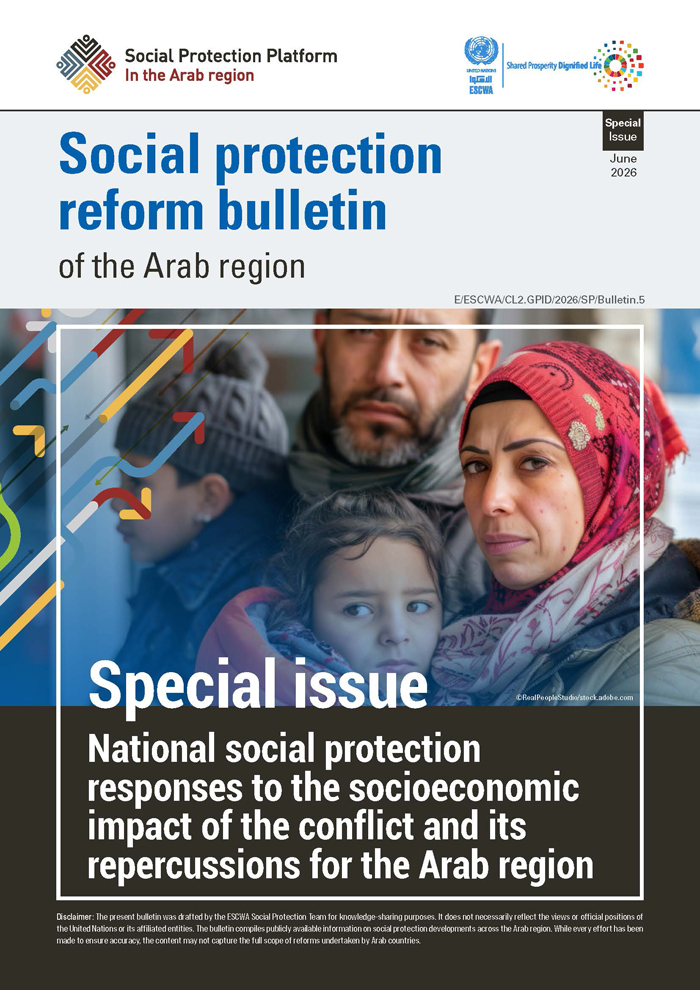

ESCWA Publication: E/ESCWA/CL2.GPID/2026/SP/Bulletin.5
Country: Arab region, Kingdom of Bahrain, Republic of Djibouti, Arab Republic of Egypt, Republic of Iraq, Hashemite Kingdom of Jordan, State of Kuwait, Lebanese Republic, Islamic Republic of Mauritania, Kingdom of Morocco, Sultanate of Oman, State of Palestine, State of Qatar, Kingdom of Saudi Arabia, Republic of Sudan, Syrian Arab Republic, Republic of Tunisia, United Arab Emirates, Republic of Yemen
Publication Type: Information material
Cluster: Gender Justice, Population and Inclusive Development
Focus Area: Inclusive development, Future of employment
Initiatives: Job creation, Reducing inequalities, Including persons with disabilities in the labour market
SDGs: Goal 8: Decent Work and Economic Growth, Goal 10: Reduced Inequalities
Keywords: Arab countries, Bahrain, Basic services, Case studies, Displaced persons, Djibouti, Economic aspects, Egypt, Government policy, Humanitarian assistance, Iraq, Jordan, Kuwait, Labour market, Lebanon, Mauritania, Morocco, Oman, Poverty mitigation, Qatar, Recommendations, Saudi arabia, Social aspects, Social security, State of palestine, Subsidies, Sudan, Syrian arab republic, Tunisia, United arab emirates, War, Yemen
Social protection reform bulletin of the Arab region - Special issue: National social protection responses to the socioeconomic impact of the conflict and its repercussions for the Arab region
July 2026
The present special issue of the “Social protection reform bulletin of the Arab region” analyses 39 social protection measures adopted by Arab Governments in response to the regional conflict that began on 28 February 2026. Using a semi-automated triangulated approach, it sets out measures drawn from official websites, government statements, news outlets and international organizations. The findings reveal that while Governments have deployed diverse measures, the majority appear to focus on ensuring the affordability of defined consumables through subsidy-centric social assistance. However, blanket subsidies can be regressive depending on the type of commodity or product being subsidized and may therefore benefit mostly those who are less vulnerable. At the same time, these broad and costly measures risk further constraining the fiscal space available for protecting directly affected groups and other vulnerable populations.
The bulletin calls for strengthened disaster preparedness and increased shock-responsiveness of social protection systems, dedicated financing mechanisms, targeted interventions with expanded and integrated national beneficiary registries, and early warning systems. Crucially, development partners should consider fostering and supporting greater alignment with shock-responsive national social protection systems.
Related content
Inclusive development, Future of employment
The present special issue of the “Social protection reform bulletin of the Arab region” analyses 39 social protection measures adopted by Arab Governments in response to the regional conflict that began on 28 February 2026. Using a semi-automated triangulated approach, it sets out measures drawn from official websites, government statements, news outlets and international organizations. The findings reveal that while Governments have deployed diverse measures, the majority appear to focus on ensuring the affordability of defined consumables through subsidy-centric social assistance. However, blanket subsidies can be regressive depending on the type of commodity or product being subsidized and may therefore benefit mostly those who are less vulnerable. At the same time, these broad and costly measures risk further constraining the fiscal space available for protecting directly affected groups and other vulnerable populations.
The bulletin calls for strengthened disaster preparedness and increased shock-responsiveness of social protection systems, dedicated financing mechanisms, targeted interventions with expanded and integrated national beneficiary registries, and early warning systems. Crucially, development partners should consider fostering and supporting greater alignment with shock-responsive national social protection systems.