ESCWA Publication: E/ESCWA/CL1.CCS/2026/Manual.2
Country: Arab region
Publication Type: Training material
Cluster: Climate Change and Natural Resource Sustainability
Focus Area: Climate change, Natural resource sustainability
Initiatives: Arab Centre for Climate Change Policies, Water-Energy-Food nexus support to post-COVID-19 recovery
SDGs: Goal 2: Zero Hunger, Goal 6: Clean Water and Sanitation, Goal 12: Responsible Production and Consumption
Keywords: Agriculture, Arab countries, Capacity building, Case studies, Ecosystems, Green economy, Manuals, Natural resources policy, Sustainable development, Technical aspects, Training programmes, Value chains, Water resources
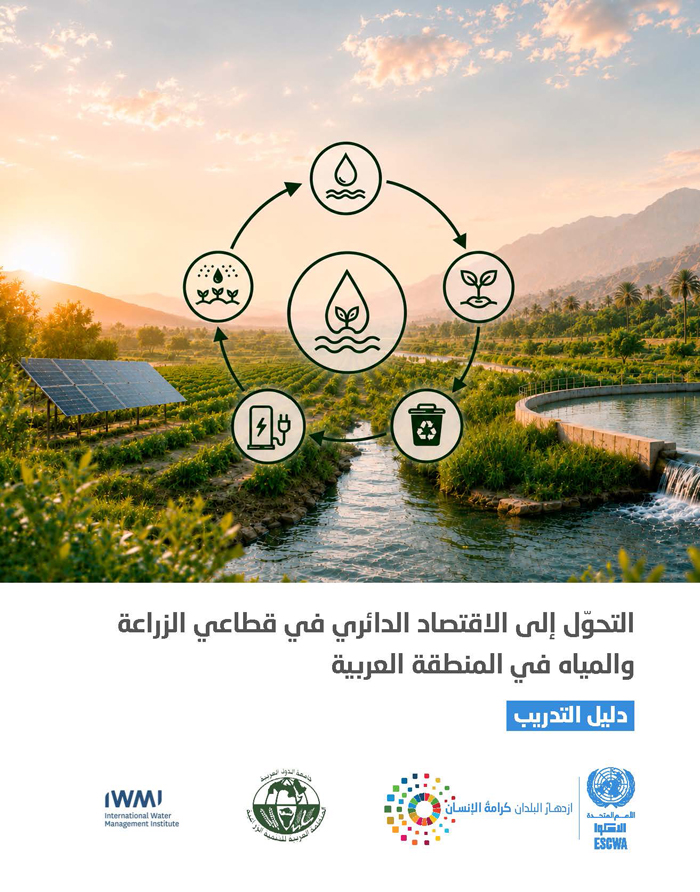
Transition to the circular economy in the agriculture and water sectors in the Arab region: training manual
September 2026
The present training manual sets out a practical framework for capacity-building and fostering the transition to a circular economy within the agriculture and water sectors of the Arab region. It was developed in response to mounting challenges, including water scarcity, land and soil degradation, high levels of food loss and waste, escalating climate change impacts, and inefficient resource use across agricultural and water value chains. The manual aims to support technicians, trainers, policymakers and professionals working in agriculture, water, the environment, and sustainable development in analysing existing systems and identifying opportunities to shift from linear models to more efficient, circular systems.
The manual introduces the core concepts and principles of the circular economy and their relevance to the difficulties and priorities of the Arab region. It then explores their application in the agriculture and water sectors by examining challenges and opportunities, circular approaches, technical solutions and practical practices, and the role of nature-based solutions. It emphasizes that the transition to a circular economy relies not only on technical solutions but also requires an integrated enabling ecosystem, encompassing policies and governance, inter-institutional and cross-sectoral coordination, business models and financing mechanisms, capacity-building, technology and digitalization, and monitoring and evaluation systems. The manual employs a flexible applied-training methodology that combines theoretical content, case studies from the Arab region and group exercises, enabling participants to design circular interventions that are both feasible and adaptable to national and local priorities and contexts.
Related content
Climate change, Natural resource sustainability
The present training manual sets out a practical framework for capacity-building and fostering the transition to a circular economy within the agriculture and water sectors of the Arab region. It was developed in response to mounting challenges, including water scarcity, land and soil degradation, high levels of food loss and waste, escalating climate change impacts, and inefficient resource use across agricultural and water value chains. The manual aims to support technicians, trainers, policymakers and professionals working in agriculture, water, the environment, and sustainable development in analysing existing systems and identifying opportunities to shift from linear models to more efficient, circular systems.
The manual introduces the core concepts and principles of the circular economy and their relevance to the difficulties and priorities of the Arab region. It then explores their application in the agriculture and water sectors by examining challenges and opportunities, circular approaches, technical solutions and practical practices, and the role of nature-based solutions. It emphasizes that the transition to a circular economy relies not only on technical solutions but also requires an integrated enabling ecosystem, encompassing policies and governance, inter-institutional and cross-sectoral coordination, business models and financing mechanisms, capacity-building, technology and digitalization, and monitoring and evaluation systems. The manual employs a flexible applied-training methodology that combines theoretical content, case studies from the Arab region and group exercises, enabling participants to design circular interventions that are both feasible and adaptable to national and local priorities and contexts.