
ESCWA Publication: E/ESCWA/CL2.GPID/2026/Policy brief.2
Country: Arab region, Global, People’s Democratic Republic of Algeria, Arab Republic of Egypt, Republic of Iraq, Hashemite Kingdom of Jordan, State of Kuwait, Kingdom of Morocco, Kingdom of Saudi Arabia, United Arab Emirates
Publication Type: Policy briefs
Cluster: Gender Justice, Population and Inclusive Development
Focus Area: Gender equality, Inclusive development
Initiatives: Reducing inequalities, Women’s rights and gender mainstreaming, Gender Justice and the Law
SDGs: Goal 5: Gender Equality, Goal 10: Reduced Inequalities
Keywords: Algeria, Arab countries, Cultural aspects, Egypt, Financial inclusion, Financial services, Gender equality, India, Iraq, Jordan, Kuwait, Law reform, Morocco, Rwanda, Saudi arabia, Social aspects, United arab emirates, Women in development, Bangladesh, Legal aspects, Digital literacy
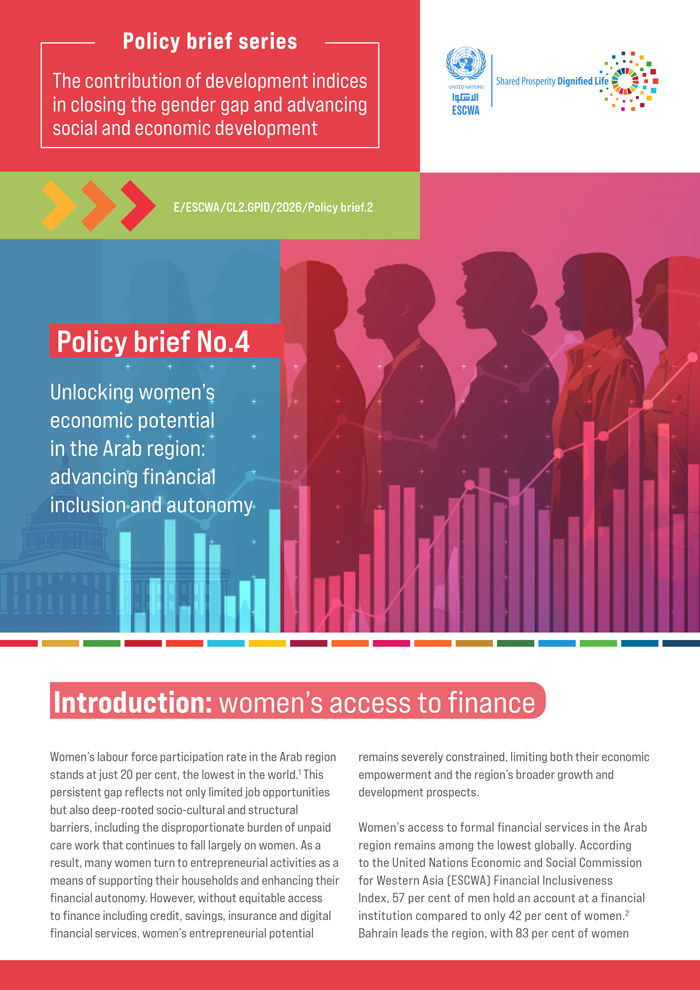
Unlocking women’s economic potential in the Arab region: advancing financial inclusion and autonomy
January 2026
This policy brief identifies the principal barriers to women’s financial inclusion in the Arab region. It highlights that legal frameworks continue to restrict women’s access to finance, while limited access to both traditional and digital financial services are major impediments to inclusion. Drawing on global and regional best practices, the brief showcases successful policy measures and concrete examples, demonstrating how these approaches can contribute to narrowing gender gaps across several dimensions.
The brief outlines policy options for Governments in the Arab region to address current barriers to women’s financial inclusion and thus enhance their performance on international development and gender equality indices.
Read more:
- Education in the Arab region: closing gaps to ensure that no child is left behind
- Women’s participation in political life in the Arab region: closing gaps to increase women’s participation in decision-making processes
- Women’s economic participation in the Arab region: recent accomplishments and remaining barriers
Related content
Gender equality, Inclusive development
This policy brief identifies the principal barriers to women’s financial inclusion in the Arab region. It highlights that legal frameworks continue to restrict women’s access to finance, while limited access to both traditional and digital financial services are major impediments to inclusion. Drawing on global and regional best practices, the brief showcases successful policy measures and concrete examples, demonstrating how these approaches can contribute to narrowing gender gaps across several dimensions.
The brief outlines policy options for Governments in the Arab region to address current barriers to women’s financial inclusion and thus enhance their performance on international development and gender equality indices.
Read more:
- Education in the Arab region: closing gaps to ensure that no child is left behind
- Women’s participation in political life in the Arab region: closing gaps to increase women’s participation in decision-making processes
- Women’s economic participation in the Arab region: recent accomplishments and remaining barriers