


Policy briefs
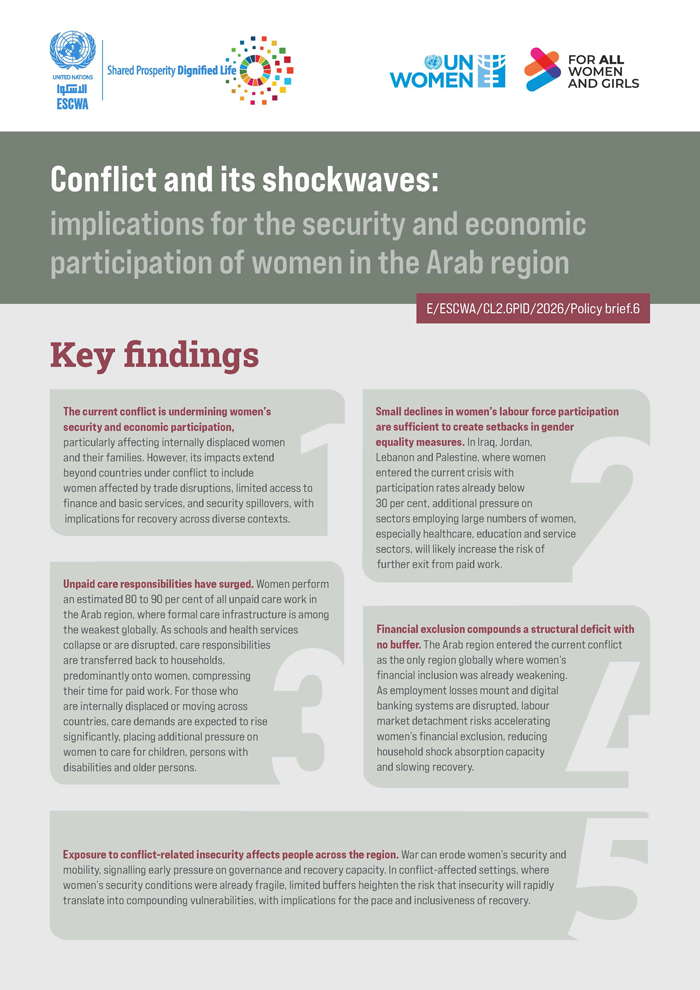
Conflict and its shockwaves: Implications for the security and economic participation of women in the Arab region
May 2026
Recognizing, reducing and redistributing care responsibilities for greater women economic participation
2020 – Ongoing

Female participation in the workforce across the Arab region remains low, largely due to the significant amount of unpaid care work women perform. The majority of these responsibilities fall on women, who dedicate considerably more time to caregiving than men. This imbalance restricts women’s ability to engage in paid employment and reinforces existing gender inequalities. Prevailing social norms that designate men as providers and women as caregivers further perpetuate this divide. Furthermore, paid workers, most of whom are women, face significant challenges related to their working conditions. As a result, women face economic, social, and political disadvantages, making them more vulnerable compared to men. The situation is likely to become more challenging as care demands rise due to demographic changes and the impacts of climate change.
The care economy significantly affects overall economic activity, with unpaid care work representing a substantial portion of total work time. Assigning value to women’s unpaid care efforts reveals their immense contribution to the global economy. Advancing policies that address care responsibilities and enhance women’s participation in the workforce is essential for fostering women’s economic empowerment, achieving gender equality, and supporting progress toward the 2030 Agenda for Sustainable Development.
ESCWA supports its member countries in promoting gender equality by advancing women’s economic empowerment and increasing their participation in the workforce. This is achieved by supporting law and policy reforms that recognize, reduce, and redistribute unpaid care work, and represent and reward paid care workers. The comprehensive approach of ESCWA includes:
• Knowledge products for in-depth analysis of care systems in the region.
• Multi-stakeholders consultations at national and regional levels to identify priorities and build consensus and momentum for necessary policy and legal framework changes.
• Capacity building on advancing care systems, and policies and legal frameworks that promote gender equality;
• Technical support for policy and legal framework changes.
At the national level, ESCWA collaborates with relevant ministries, parliaments and national women machineries, in addition to private sector and civil society organizations and academia that may be able to support.
At the regional level, ESCWA collaborates with UN WOMEN and the International Labour Organization (ILO) on a regular basis, as well as the League of Arab States and other UN organizations.
At the inter-regional level, ESCWA regularly collaborates with ECLAC and ESCAP, and other international organizations as relevant.
At the national level:
ESCWA conducted and published several country-specific case studies focused on women’s economic empowerment and care policies in Saudi Arabia, Morocco, Oman, and Lebanon.
In Morocco, efforts are ongoing with the Ministry of Justice to value unpaid care work as part of family code reform.
In Oman, ESCWA supported discussions and continues to assist with labor law amendments concerning maternity leave for children with disabilities.
In Lebanon, ESCWA facilitated multi-stakeholder dialogues and legal studies that led to significant labor law proposals on flexible work, parental leave culminating in the adoption of flexible work legislation in 2025. Throughout, ESCWA provided legal and technical support, helped develop action plans, and conducted advocacy campaigns. In response to the 2024 war in Lebanon, ESCWA and the Lebanese Parliament produced a policy brief promoting the integration of care policies into national recovery efforts.
At the regional level:
ESCWA has facilitated knowledge exchange among Arab countries by developing guidelines and analytical papers on advancing care policies, the impact of COVID-19 on gender equality, and the role of caregivers. These resources support technical assistance for policy reforms. ESCWA has also organized multiple regional workshops and meetings—in collaboration with partners like LAS, UN Women, and ILO—to build capacity and promote women’s economic participation and care policy development.
Concluded events on Care Systems are:
A series of pulication and narratives was developed on the subject. These are:


 Amman, Jordan