16 December 2025
10:00–11:30
Beirut time
Webinar

Digital-Intelligent Resilient Power Grids

Flyer
Location
  • Online
Organizer
Contact information
Share

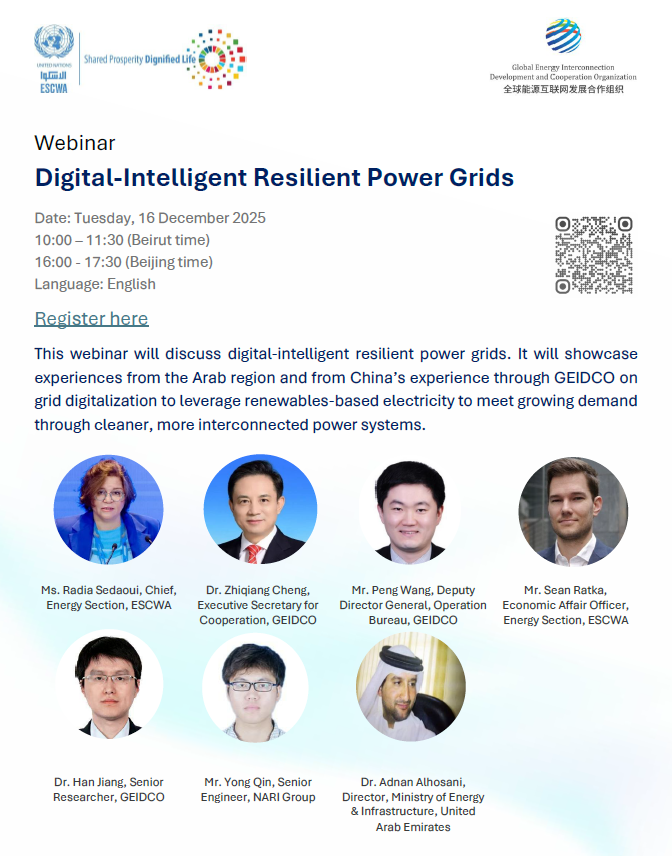
ESCWA and the Global Energy Interconnection Development and Cooperation Organization (GEIDCO) are co-hosting this capacity building webinar, bringing together experts from China and the Arab region to explore how advanced digital technologies can support grid modernization and sustainable energy transition. The event highlights concrete applications of automation, AI enabled forecasting, wide area monitoring and other tools that improve the flexibility, reliability and resilience of power systems. 

The webinar also presents global trends in digital intelligent grid solutions, introduces the work of ESCWA on digital governance and power system resilience, and showcases practical experience from GEIDCO, State Grid NARI Group and from the Arab region. Participants gain insights into integrating decentralized renewables into grids and managing cybersecurity and data governance challenges.

Outcome document

  • Grid digitalisation is essential for added resilience. As systems become more complex, digital-intelligent solutions help utilities anticipate stress, improve situational awareness, and speed up restoration.
  • Smart metering and advanced metering infrastructure (AMI) can create value beyond billing, enabling outage detection, line-loss analytics, anti-tampering, and improved operational planning.
  • Data governance is foundational. To scale solutions responsibly, countries need stronger approaches to interoperability, cybersecurity, data protection, and institutional coordination.
  • Capacity and skills matter as much as technology. Participants raised skills needs for handling large volumes of grid and meter data, and the importance of pairing digital deployment with workforce development.
  • Cybersecurity must evolve alongside digitalisation. The UAE case study reinforced that expanding connectivity in critical infrastructure requires governance and modern security models (including Zero Trust approaches such as blockchain).
  • Phased implementation reduces risk. China’s experience illustrates gradual meter replacement cycles and stepwise AMI rollout, with attention to communications testing and system integration.
  • Smart meters can support loss reduction and revenue protection, including through tamper detection and data-driven line-loss calculation.
  • Regional knowledge exchange accelerates progress. The session highlighted the value of learning across contexts, including China and the UAE, while tailoring approaches to country realities in the Arab region.
  • Regional interconnection and ecosystem integration should be treated as part of the digitalisation agenda, with cooperation on standards, technology and market integration to enable more resilient and efficient cross-border power exchange.
  • Digital-intelligent grids require an enabling foundation that links data, computing and intelligence, including stronger data collection and sharing and cloud computing to support scalable, system-wide applications.
  • Utilities should prepare for next-generation operational applications, including human-machine collaborative dispatch, virtual power plants, and more autonomous operations and maintenance enabled by advanced AI.
  • ESCWA presented why power sector digitalisation is increasingly essential, noting that digital tools and AI can improve renewable forecasting, optimize dispatch and congestion management, and enable predictive maintenance and digital twins, while barriers remain around cybersecurity, interoperability, skills, and regulatory readiness.
  • ESCWA also highlighted its work on energy sector digitalisation, including analytical work, policy dialogues, and advisory services, and linked this webinar to the upcoming multi-country project on digital governance of power grids as well as ESCWA’s ongoing solar mapping project.

Digital-Intelligent Resilient Power Grids (GEIDCO)

  • The presentation introduced the concept of Digital-Intelligent Resilient Power Grids (DIRPG) as a new generation of power grids that integrates resilient UHV/EHV infrastructure with digital-intelligent technologies, aiming to enhance climate elasticity, stability resilience, regulatory flexibility, intelligent interactivity and ecosystem integration.
  • It highlighted key drivers for DIRPG, including growing system complexity and uncertainty (including climate and meteorological factors), large-scale integration of diverse components and resources, and the need for more efficient data sharing and system-wide coordination.
  • The presentation outlined a core framework for development, including the physical foundation of wide-area transmission, flexible distribution and autonomous microgrids, supported by stronger cooperation among data, computing and intelligence to enable advanced operational applications such as human-machine collaborative dispatch and virtual power plants.


Advanced Metering Infrastructure and smart meter data applications (NARI Group)

  • The presentation outlined the rationale and architecture for AMI, emphasizing benefits such as reducing manual meter reading and troubleshooting costs, improving measurement accuracy, enabling outage detection, and supporting line-loss reduction through tamper-event detection.
  • China’s AMI experience was presented at scale, including 600 million meters connected and a daily collection success rate above 99.5%, enabling near real-time abnormal detection and faster analytics for consumption, load and loss calculations.
  • The presentation also highlighted practical deployment sequencing, including standards-setting, interoperability testing, system deployment, device installation and system integration.


Digital innovations in the UAE (UAE Ministry of Energy and Infrastructure)

  • The UAE case study described national initiatives on smart grids, data analytics and protection and control systems, alongside a strong cybersecurity focus using frameworks such as Zero Trust and compliance with relevant national standards.
  • A specific example highlighted the Emirates Monitoring Center’s coordination role and partnerships with utilities and regional interconnection actors, with reported impacts including improved grid reliability, cybersecurity resilience, operational efficiency and the growing use of AI for predictive analytics.
  • The Q&A focused on practical implementation issues and how digital tools can be applied in utility contexts. Participants asked how smart meter and AMI data can be used for medium- and long-term planning, including 5–10 year demand forecasting, assessing the impacts of behind-the-meter solar PV, and improving distribution network investment decisions. Several questions explored how meter data can quantify electric vehicle charging trends and guide transformer and feeder upgrades.
  • Participants also discussed the feasibility of AMI deployment in challenging environments with weak grids, including communications infrastructure constraints, expected rollout timelines, and the relative suitability of communications options. Responses emphasized the importance of testing communications performance and highlighted high-performance power line communications as a potentially relevant option in constrained settings.
  • There was also interest in data integrity and governance, including whether blockchain is used to verify the provenance and authenticity of datasets, and broader questions on how to manage and analyse large data volumes to reduce technical and non-technical losses. Finally, participants asked about expected loss-reduction impacts from smart grids and AI-enabled approaches; discussion emphasized that outcomes depend on system conditions, but that smart meters and analytics can support theft detection, line-loss analysis, and more targeted operational interventions.

Related news

arrow-up icon
Feedback