16 June 2025
14:00–15:30
Beirut time
Expert Group Meeting

Mapping solar energy access in Jordan

Location
  • Online
Contact information
Share

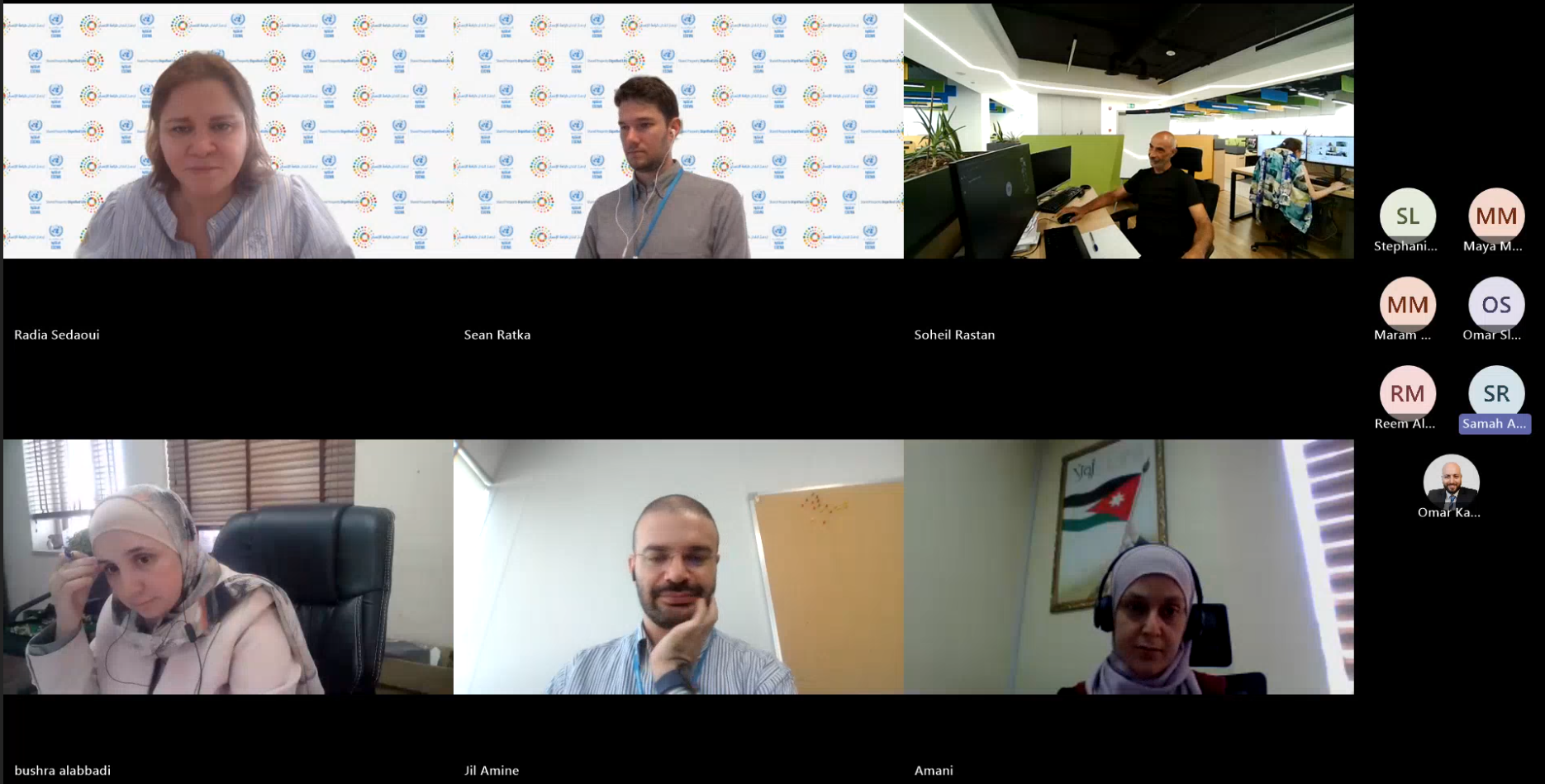
In the framework of a series of consultation meetings on mapping solar energy access in the Arab region, ESCWA is organizing a national consultation meeting with representatives from the Ministry of Energy and Mineral Resources and the Department of Statistics in Jordan. The objectives of the meeting include informing representatives of the ESCWA project on "Improved mapping and monitoring of solar energy access for enhanced climate policy action and socio-economic resilience in ESCWA member States" (IMSE); assessing current capabilities and availability of data in Jordan; and identifying technical and policy gaps and challenges.

The meeting provides a platform to explore how national data systems and mapping tools can be strengthened to support solar energy planning and policy development. It also aims to enhance collaboration between energy and statistics institutions in Jordan, and to identify opportunities for capacity-building and data integration under the IMSE project.

Outcome document

  • A survey will be circulated among all stakeholders in Jordan to gather more detailed information.
  • Through the project, ESCWA will support capacity-building efforts and facilitate data-driven policy development.

The meeting commenced with welcoming remarks from ESCWA, followed by a brief introduction of the IMSE project, which aims to support countries in mapping renewable energy applications to inform decision-making and policy development. The project includes virtual coordination meetings, regional training workshops, and stocktaking exercises. The key points discussed were: 

  • ESCWA outlined the project’s objectives:
    • Assess technical and GIS capabilities for renewable energy monitoring.
    • Evaluate policy knowledge and data-informed decision-making.
    • Understand human capital capacity for strategic RE mapping.
    • Build institutional capacity to support SDG7, with a focus on solar energy.
  • MEMR shared insights into the ministry’s data management efforts:
    • The Data Management Unit is still in its initial phase, focusing on identifying business needs and structuring databases.
    • Monthly aggregate data is available from distribution and transmission companies for grid-connected solar systems.
    • Efforts are ongoing to collect more detailed system-level data for performance analysis.
    • Off-grid and SWH data is limited, fragmented, and stored in various formats across departments.
    • No centralized or automated system exists; data is typically shared via Excel files over email.
    • A digital SCADA system is used by national electricity companies, but broader integration is still in progress.
    • Off-grid systems under 1 MW may not be consistently tracked, and reliable data on their number or capacity is lacking.
    • Net-metering is expanding.
    • The Fils Al Reef program was proposed as a case study to explore solar access and socio-economic impacts.
  • DOS noted that:
    • It lacks GIS-mapped energy data and satellite imagery.
    • Collaboration with MEMR exists, but GIS use is limited to non-energy sectors.
    • It holds macroeconomic, environmental, and demographic data that can be geographically mapped.
    • There is no centralized geographical mapping of renewable energy infrastructure.
  • The challenges identified during the meeting were:
    • Lack of real-time, disaggregated, and accurate data.
    • Inconsistent data sources (e.g., EMRC vs. operators).
    • Limited use of data in policy formulation, due to inconsistency and inaccuracy.
    • Incomplete data hinders donor engagement and resource mobilization.
arrow-up icon
Feedback