The Arab region has made progress towards achieving Sustainable Development Goal (SDG) 7 targets, but continues to lag behind other regions in renewable energy penetration. Renewables accounted for only 5 per cent of the Arab region’s total energy consumption in 2022. There is a pressing need to accelerate efforts through improved mapping and monitoring of solar energy capacity and potential, and targeted interventions to ensure sustainable energy for all.
In the region, there are challenges to national data collection and the production of timely, disaggregated and accurate data on renewable energy access. This is due to the absence of clear national policies and frameworks for digital data collection, management and sharing, as well as limited technical and human resources and expertise in national statistical agencies. These difficulties and their root causes hinder the ability of policymakers to track progress relative to national baselines and targets and implement informed policies based on quality data.
Our approach
This initiative aims to enhance capacities to map and monitor developments in solar energy access in order to strengthen data-driven analysis and improve evidence-based policymaking for climate action and socioeconomic resilience. It focuses on two main pillars:
- Enhancing the capacity of government officials and policymakers working in statistics, energy and research centres on using digital and geospatial tools.
- Strengthening the capacity of policymakers and government officials to develop evidence-based solar energy policies.
Our partners
This initiative is funded by the United Nations' Development Account.
Partner:
- The National Council for Scientific Research – Lebanon
Our activities
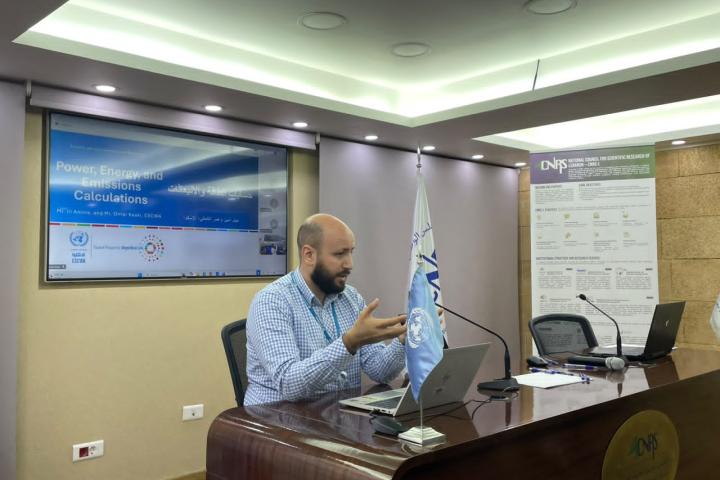
- Organizing a regional consultation workshop to assess the availability and quality of data on solar energy access.
- Organizing three national consultations on technical and policy capacity to identify gaps and opportunities related to renewable energy and solar energy.
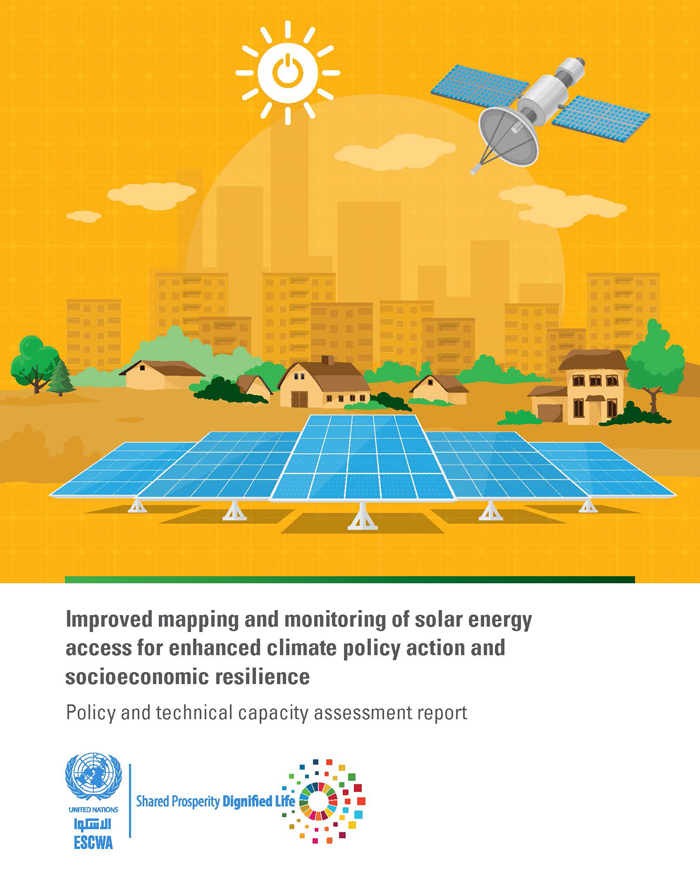
- Developing policy and technical capacity assessment report to evaluate the policy landscape to ensure alignment with SDG7 and climate commitments and provide recommendations for policy opportunities and enhancements that address energy access and poverty and evaluate the human and technology resources available.
- Developing a digital platform and an interactive technical toolkit to build the capacity of the targeted government officials on using GIS, satellite imagery, and remote sensing tools.
- Organizing national capacity-building workshops and a study tour to train targeted government officials on utilizing the platform and applying the toolkit.
- Organizing online regional workshops to facilitate peer-to-peer exchanges.
- Organizing an online stocktake on the findings of the assessment reports and outputs of the platform to assess and review progress made towards SDG7 and related indicators.
- Developing a regional policy toolkit on the process of evidence-based policymaking using solar energy data, maps and analysis to inform policy assessment, planning and development.
- Organizing a regional capacity-building workshop on the use of the assessment of existing policies, the policy toolkit and the generated solar energy access maps.
- Organizing national policy dialogues to review and finalize the solar energy policy proposal for consideration in future legislation.
- Organizing an online regional workshop to support lawmakers, policymakers, government officials and representatives of rural authorities to adopt an integrated approach where the uptake of renewable energy can be used as an enabler to improve socioeconomic resilience and accelerate climate action.
- Organizing an online event to disseminate the project’s achievements and discuss opportunities for upscaling and replicability potential.




 UN House, Beirut