21 May 2025
11:00–14:00
Beirut time
Expert Group Meeting

Meeting of ESCWA Expert Group on Extractive Industries

منشور الفعالية
Location
  • Online
Contact information
Share

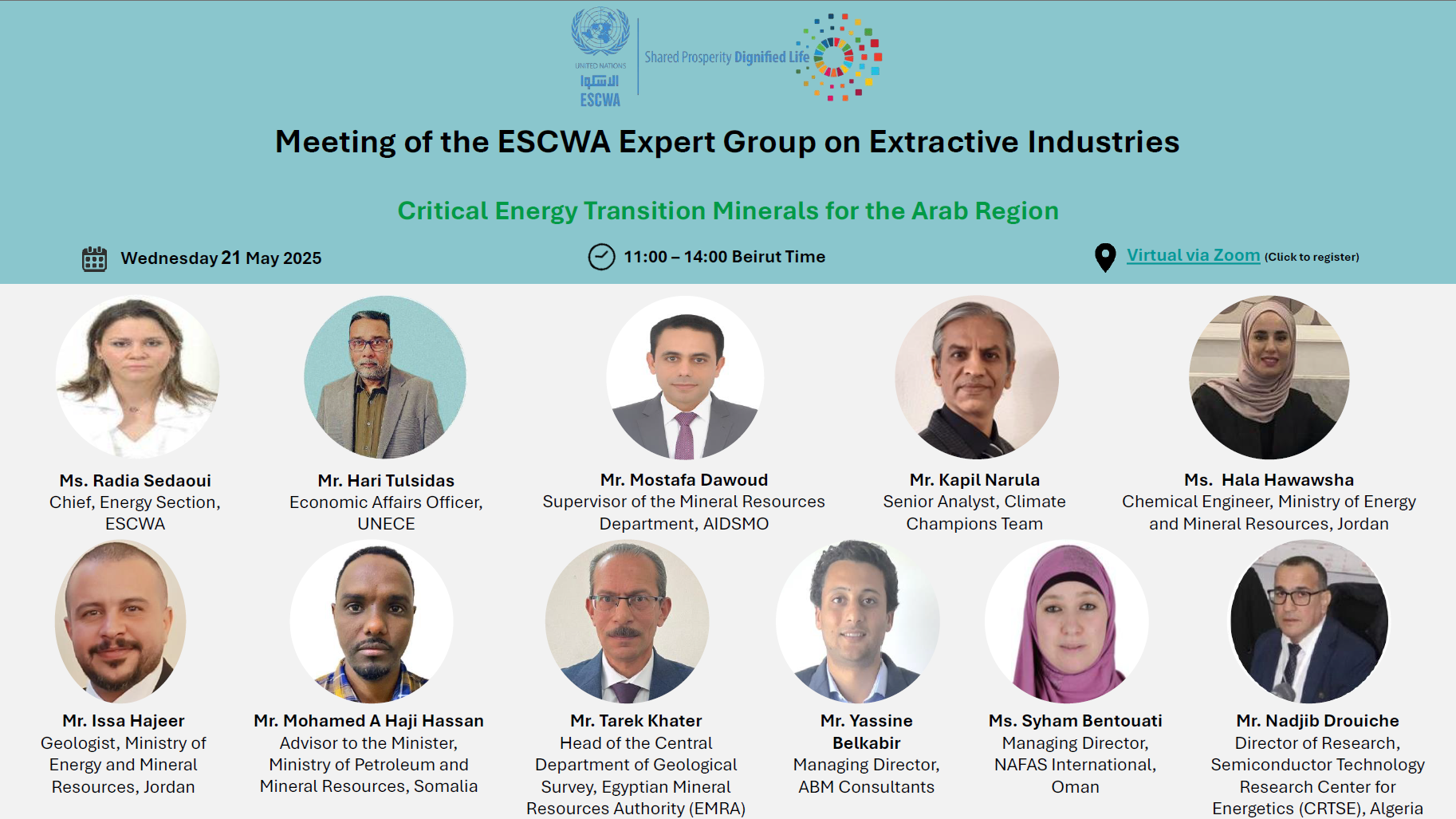
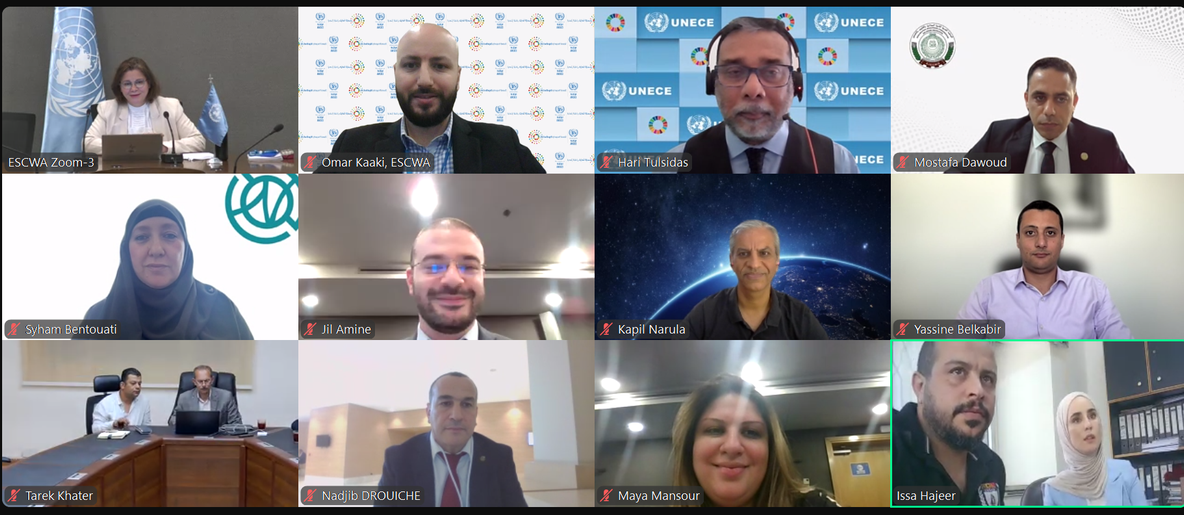
Within the framework of the ESCWA Expert Group on Extractive Industries, which is a sub-committee of the ESCWA Committee on Energy, ESCWA is organizing a meeting of the expert group to provide a regional platform to exchange knowledge and best practices. The meeting focuses on exploring pathways towards just and inclusive critical energy transition minerals in the Arab region.

Outcome document

The following recommendations were made by the ESCWA Expert Group on Extractive Industries:

  1. Coordinate/align sustainable energy strategies with critical energy transition minerals (CETMs) programs/strategies;
  2. Mainstream the principles of the UN Secretary-General’s Panel on CETMs and the use of the United Nations Resource Management System (UNRMS) in the mining sectors;
  3. Build domestic and/or regional value addition and industrialization capabilities;
  4. Facilitate the adoption of circular economy principles for sustainable supply chains;
  5. Invest in human capital and capacity building to improve the skills needed in the local workforce and target youth;
  6. Leverage public-private partnerships for driving innovation, providing funding, and ensuring the scalability of projects, particularly in infrastructure development and technological advancement;
  7. Promote research and development and technology transfer by enhancing North-South and South-South collaboration;
  8. Update regulations to reflect global standards in environmental protection, social responsibility, and economic governance;
  9. Enhance regional cooperation to develop comprehensive value chains by classifying countries based on their reserves, value chain, and markets;
  10. Provide targeted support to conflict-affected countries to help them leverage their natural resources effectively by developing policies that address the unique challenges they face;
  11. Enhance data sharing and traceability using GIS and AI tools for geological data, contracts, prices, trade and policies.
  • ESCWA explored the Arab region's role and opportunities in the global shift toward CETMs where it highlighted the increasing global demand for minerals.
  • It shed light on how the Arab region, rich in mineral fuels and other resources, holds significant potential to contribute to this transition and presented challenges such as energy access disparities, especially in rural areas, and the need for economic diversification remain.
  • UNECE outlined how the United Nations Resource Management System (UNRMS) can enhance transparency, accountability, and sustainability in Critical Raw Materials (CRM) value chains.
  • It emphasized a lifecycle approach, from exploration to reuse, aligned with the UN Framework Classification (UNFC), embedding environmental, social, and governance (ESG) principles and circular economy practices from the outset.

A live demonstration of the AIDSMO Arab Platform for Future Minerals ensued where the platform’s various features and sections were showcased such as coverage of 21 Arab countries, 38 clean energy minerals, 53 industrial minerals, 5,574 sites, and 145 investment opportunities; the classification of minerals; the granular data on minerals production and demand in each country; historic and current prices of minerals; and the GIS map of minerals in the Arab region which includes a multitude of layers (geology, industrial minerals, clean energy minerals, infrastructure, etc.).

  • The presentation emphasized the critical role of international cooperation in advancing the agenda on CETMs to support global climate action. It highlighted the rapid yet uneven adoption of clean energy technologies and the heavy concentration of clean tech manufacturing in China.
  • To address these imbalances, the presentation proposed establishing an International Critical Minerals Observatory, integrating CETMs into multilateral forums, and creating a global fund to support just transitions in mining.
  • The presentation covered Jordan’s minerals strategy which aims to enhance energy security and economic growth by leveraging its rich resources—phosphates, potash, lithium, and more—for clean energy technologies.
  • It addresses challenges like limited processing and high energy costs through public-private partnerships, foreign investment, and renewable energy integration. The strategy targets job creation, GDP growth, and positioning Jordan as a regional hub for processed minerals.
  • The presentation highlighted Somalia’s underdeveloped but resource-rich mining sector, with minerals like gold, copper, uranium, and bauxite offering potential for economic growth and diversification. While past exploration was fragmented and recent activity mostly artisanal, the sector faces challenges such as outdated data, weak regulations, and safety risks.
  • The government is addressing these through legal reforms, institutional strengthening, modern surveys, and efforts to attract investment. Emphasis is placed on sustainable development, environmental and community safeguards, and leveraging mineral wealth for long-term economic and social progress.
  • The presentation outlined Egypt’s Vision 2030 strategy to become a regional leader in clean energy and sustainable resource management. It emphasized the country’s rich mineral resources—such as gold, phosphate, lithium, and rare earth elements—and efforts to modernize the mining sector through reforms, digital tools, and ESG integration.
  • Despite infrastructure and investment challenges, Egypt is advancing downstream industries, promoting green finance, and encouraging regional and international collaboration to strengthen supply chains and drive sustainable growth.
  • The presentation showcased Morocco’s strategic role in the global energy transition by leveraging its critical minerals sector, particularly in lithium, copper, and cobalt. With strong industrial sectors and reforms like a new mining code and ESG frameworks, Morocco is investing in green mining, digital traceability, and regional integration.
  • Supported by international financing, case studies from OCP and Managem highlight sustainable innovation. Despite challenges like limited local value addition and lack of UNFC/UNRMS alignment, the presentation urged adopting global standards and enhancing ESG compliance to position Morocco as a regional leader in green mining diplomacy.
  • The presentation highlighted Oman’s Vision 2040 strategy to diversify its economy and lead in the energy transition through large-scale solar, wind, and green hydrogen projects. With over 4.5 GW of solar and 1.2 GW of wind capacity expected by 2029, Oman is also exploring its geological potential in critical minerals.
  • Though not yet a major producer, the country is investing in exploration, downstream processing, and circular economy practices, including battery recycling. Innovative initiatives like mineral extraction from hypersaline water and regional collaboration were also emphasized as part of Oman’s sustainable development approach.
  • The presentation detailed Algeria’s strategy to harness its mineral wealth—especially iron, phosphates, and lithium—for a sustainable energy transition focused on Lithium-Iron-Phosphate (LFP) battery production. With major projects and partnerships, Algeria aims to build a full battery supply chain, create over 150,000 jobs, and align with global CETM supply chains.
  • The strategy emphasizes ESG compliance, renewable energy use, and regional cooperation under ESCWA and UNRMS. It concluded with a call to accelerate investment, adopt responsible mineral governance, and align strategic projects with the SDGs and green industrialization goals.

Related news


arrow-up icon
Feedback