
ESCWA Publication: E/ESCWA/CL1.CCS/2026/Policy Brief.4
Country: Arab region, Kingdom of Bahrain, Republic of Djibouti, Islamic Republic of Mauritania, Kingdom of Morocco, State of Qatar, Kingdom of Saudi Arabia, Republic of Sudan, Republic of Tunisia, United Arab Emirates, Republic of Yemen
Publication Type: Policy briefs
Publication Subject: Conflict and Its Shockwaves
Cluster: Climate Change and Natural Resource Sustainability
Focus Area: Natural resource sustainability
Initiatives: Arab Centre for Climate Change Policies
SDGs: Goal 2: Zero Hunger, Goal 6: Clean Water and Sanitation, Goal 7: Affordable and Clean Energy, Goal 11: Sustainable Cities and Communities, Goal 12: Responsible Production and Consumption
Keywords: Arab countries, Bahrain, Desalination, Djibouti, Energy resources, Energy prices, Energy transfer, Environmental damage, Food prices, Food security, Food supply, Gulf states, Marine pollution, Mauritania, Morocco, Natural gas, Petroleum prices, Qatar, Resilience, Saudi arabia, Sudan, Trade routes, Tunisia, United arab emirates, War, Water resources, Water supply, Yemen
Conflict and its shockwaves: escalating impacts and risks for energy, water and food systems in the Arab region
April 2026
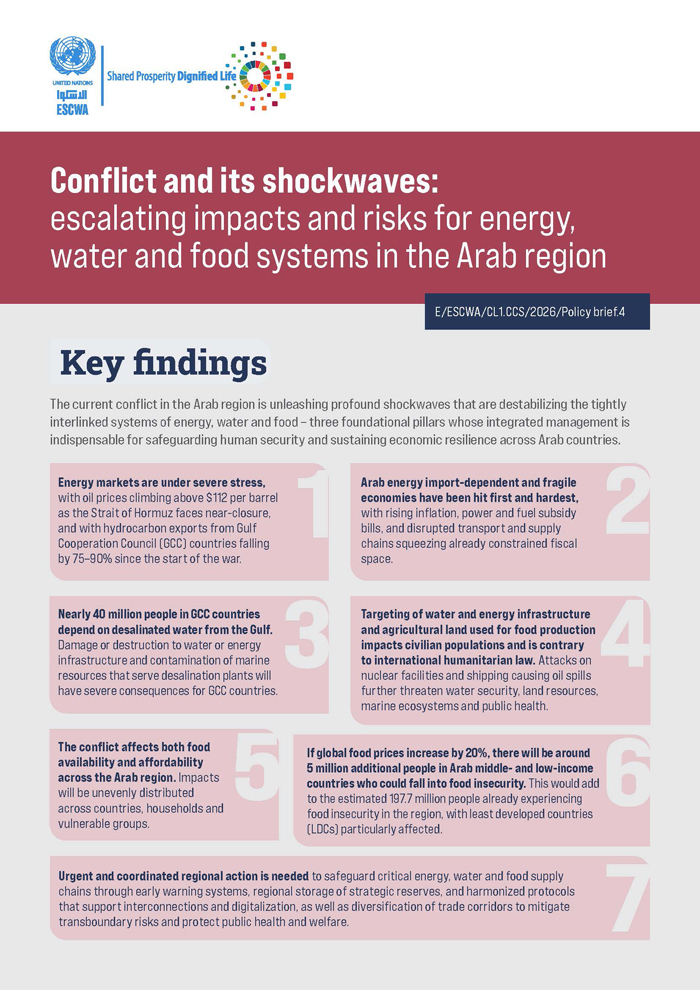
The conflict in the Arab region is placing increasing strain on interconnected energy, water and food systems. The near closure of the Strait of Hormuz has driven sharp increases in energy prices, constrained oil and liquefied natural gas exports, and intensified fiscal pressures on already fragile economies. Damage to energy infrastructure, along with elevated insurance and transport costs, has further reduced supply from traditional markets, prompting both producers and consumers to seek alternative sources. Water security risks have also intensified, particularly in Gulf Cooperation Council countries that rely heavily on desalination from Gulf waters. At the same time, disruptions to food imports, fertilizer supplies and agricultural production are amplifying price shocks and deepening vulnerabilities, especially in low-income, food import-dependent Arab countries with limited reserves.
Transboundary environmental risks are compounding these challenges, contributing to greater insecurity across energy, water and food systems, and underscoring the need for stronger early warning mechanisms. The present policy brief highlights the urgency of coordinated regional action to secure critical supply chains, strengthen strategic reserves, diversify trade routes, and enhance resilience across these interconnected systems.
Related publications: Conflict and Its Shockwaves
Related content
Natural resource sustainability
The conflict in the Arab region is placing increasing strain on interconnected energy, water and food systems. The near closure of the Strait of Hormuz has driven sharp increases in energy prices, constrained oil and liquefied natural gas exports, and intensified fiscal pressures on already fragile economies. Damage to energy infrastructure, along with elevated insurance and transport costs, has further reduced supply from traditional markets, prompting both producers and consumers to seek alternative sources. Water security risks have also intensified, particularly in Gulf Cooperation Council countries that rely heavily on desalination from Gulf waters. At the same time, disruptions to food imports, fertilizer supplies and agricultural production are amplifying price shocks and deepening vulnerabilities, especially in low-income, food import-dependent Arab countries with limited reserves.
Transboundary environmental risks are compounding these challenges, contributing to greater insecurity across energy, water and food systems, and underscoring the need for stronger early warning mechanisms. The present policy brief highlights the urgency of coordinated regional action to secure critical supply chains, strengthen strategic reserves, diversify trade routes, and enhance resilience across these interconnected systems.
Related publications: Conflict and Its Shockwaves